A First Visit To A Casino Poker Room
A dedicated casino poker room operates by entirely different dynamics than the surrounding gaming floor. You compete against fellow travelers rather than the house, while professional dealers oversee the action under precise procedural rules. Understanding how to check in at the podium, read table stakes, calculate the house rake, and observe table etiquette ensures a confident transition into live play.
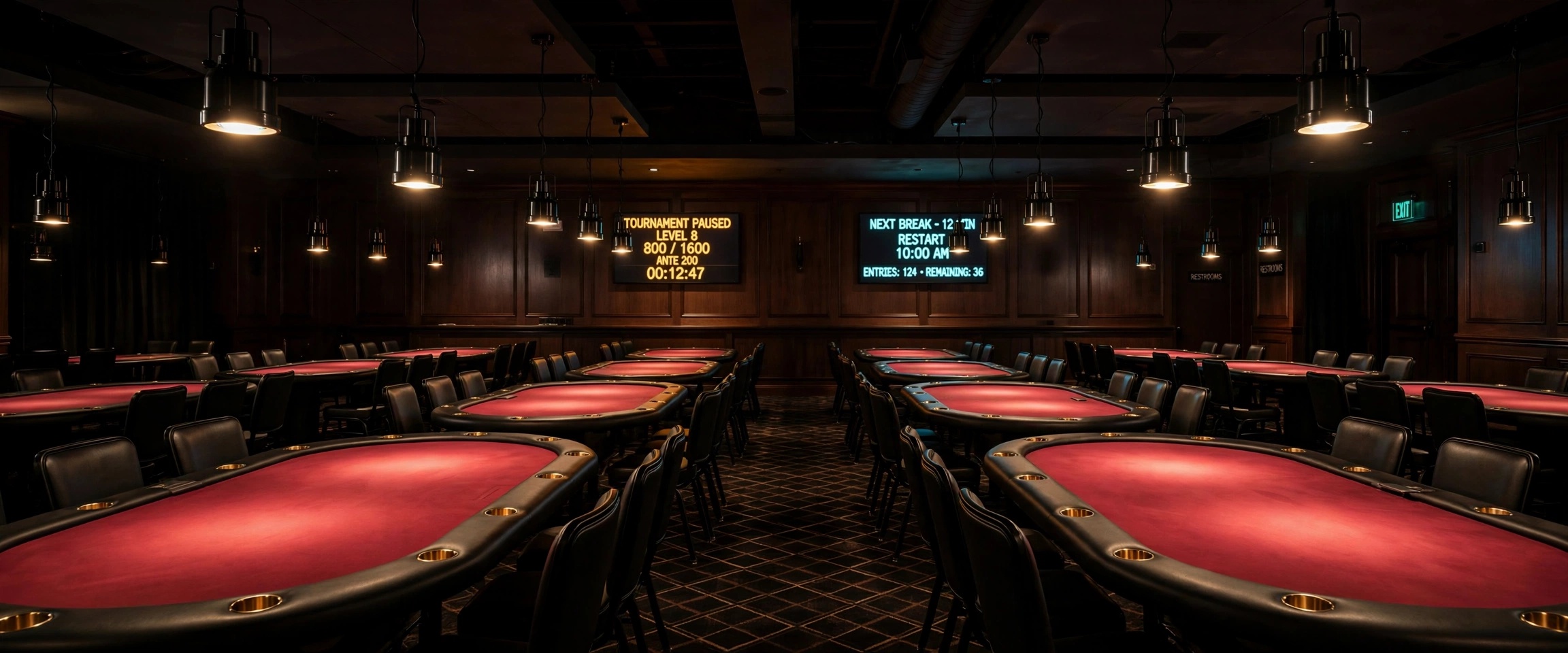
Peer Gaming Versus House-Banked Games
In blackjack, roulette, or baccarat, the casino acts as the financial adversary: when you win, the house pays you; when you lose, the house collects your bet.
In a dedicated poker room, the casino does not hold an interest in which player wins a hand. The property acts purely as an impartial administrator, providing the table, trained dealer, security surveillance, chips, and cards. Because players contest pots solely against one another, poker is the one area within a casino resort where superior knowledge, strategic discipline, and psychology can overcome short-term variance over multi-year horizons.
Cash Games Versus Tournament Formats
Before requesting a seat, players must distinguish between two primary formats:
- Cash Games (Ring Games): Chips placed on the felt represent real currency at all times. You can buy in at any point within the table's minimum and maximum limits, and you are free to pick up your chips and leave whenever you choose. If you lose your chips, you may re-buy immediately.
- Tournaments: All participants pay a uniform entry fee (buy-in plus administrative fee) in exchange for an identical stack of tournament chips. Play continues through escalating blind levels until players are eliminated. Prizes are awarded strictly to the top finishers (typically the top 10% to 15% of the field). Once you register, your financial risk is capped at the entry fee.
Decoding Stakes, Blinds And Buy-In Limits
Cash games are displayed on room digital boards by their mandatory forced bets (blinds). In No-Limit Texas Hold'em, the most common beginner and recreational stakes are:
- $1/$3 No-Limit: The small blind is $1; the big blind is $3. Typical buy-in limits range from a minimum of $100 to a maximum of $300 or $500.
- $2/$5 No-Limit: The small blind is $2; the big blind is $5. Buy-in limits generally range from $200 up to $1,000. Play at this level features deeper strategic planning and aggressive post-flop betting.
- $5/$10 and Higher: Found in marquee rooms such as Bellagio and Wynn, where buy-ins begin at $1,000 and frequently have no upper cap.
A general guideline derived from academic bankroll models is to sit with at least 100 big blinds ($300 at a $1/$3 table) to retain strategic flexibility on future betting rounds.
The Podium, The Brush And Getting Seated
When entering a casino poker room, do not walk directly to an open chair at a table. Proceed directly to the main counter at the front of the room, known as the "Podium" or "Brush":
- State your initials and the game and stakes you wish to play (e.g., "$1/$3 No-Limit Hold'em").
- The floor manager will add your name to the electronic waiting list displayed on monitors throughout the room.
- When your name or initials are called, the manager will announce your table and seat number (e.g., "Table 14, Seat 5").
- You may purchase chips directly from the poker room cashier cage before sitting down, or place cash flat on the table and ask the dealer for chips upon arrival. Once a hand is dealt, cash cannot play directly from the felt.
Essential Live Table Etiquette Rules
Live poker rooms observe strict conventions designed to maintain integrity and respectful pace:
- Act Strictly In Turn: Never fold, bet, or raise before the action has reached your position. Acting prematurely gives unfair information to players seated before you.
- No String Betting: When making a bet or raise, move all intended chips across the betting line in a single, continuous forward motion. Do not drop three chips, reach back to your stack, and drop four more. Alternatively, verbalize your exact action first (e.g., "Raise to twenty-five"), which is legally binding.
- Protect Your Hole Cards: Keep your two hole cards flat on the table, cupped beneath your hands when viewing them, and place a chip or protective marker on top of them. An unprotected hand that touches discarded muck cards is ruled dead.
- One Player to a Hand: Never discuss an active hand while cards are in play, even if you have already folded. Suggesting what cards you folded or what an opponent might hold compromises game fairness for the remaining participants.
- Show One, Show All: If you show your cards to a neighbor at the table upon winning or folding, you are required to expose them to all participants at the table upon request.
Rake Mechanics And Dealer Tipping Conventions
To cover room overhead, staff payroll, and generate profit, the casino extracts revenue through the "Rake":
- Potside Percentage Rake: In lower stakes games ($1/$3 and $2/$5), the dealer slices a fixed percentage (commonly 5% to 10%) from each pot that sees a flop, capped at a maximum of $4 to $6. If a hand ends before the flop (everyone folds to a pre-flop raise), standard etiquette dictates "No Flop, No Drop" (zero rake taken).
- Timed Seat Collection: In high-stakes rooms ($10/$25 and up), dealers do not rake pots. Instead, every player pays a flat timed fee (typically $7 to $10 every thirty minutes) to maintain their seat.
In American poker rooms, professional etiquette expects the winner of a contested pot to slide a $1 or $2 tip to the dealer when the pot is pushed. Tipping is discretionary and customary, but not legally mandatory.
Anatomy Of A Live Casino Poker Table
A visual orientation of table positions, dealer mechanics, and chip management:
Cash Game Stakes Comparison Matrix
Standard operating characteristics across common poker room limits in Las Vegas and regional gaming hubs:
| Blind Level | Standard Buy-In Range | Recommended Bankroll | Rake Method | Opponent Skill Profile |
|---|---|---|---|---|
| $1/$3 No-Limit | $100 to $300 | $300 (100 big blinds) | 10% Capped at $5 + $1 Promo | Recreational tourists, occasional regulars |
| $2/$5 No-Limit | $200 to $1,000 | $500 to $1,000 | 10% Capped at $5 + $1 Promo | Serious local players, deep-stacked tourists |
| $5/$10 No-Limit | $500 to $2,500 | $1,500+ | Timed Collection ($7 - $8 / half-hour) | Professional players, high-net-worth recreation |
| $10/$25+ High Limit | $2,500 to Uncapped | $5,000+ | Timed Collection ($9 - $10 / half-hour) | Elite professionals, private game participants |
Poker Room Presence Across Our Evaluated Resorts
A major distinction between global destinations is the physical presence of dedicated poker rooms:
- Bellagio (Las Vegas): Legendary 40-table room. Runs daily cash games across all limits and hosts major World Poker Tour (WPT) festivals. High-stakes mixed games take place in the glass-walled Legends Room.
- Wynn Las Vegas: Modern 28-table room with exceptional player comfort, USB chargers at every seat, continuous food service, and the prestigious Wynn Millions tournament series.
- Marina Bay Sands & The Venetian Macao: Live peer-to-peer poker is absent. The gaming floors in Singapore and Macao are heavily optimized for house-banked games such as baccarat, sic bo, and roulette.
- Atlantis Paradise Island: While previously the home of major international winter tournaments, routine daily cash game poker is limited; check current tournament festival schedules before planning a poker trip.
Frequently Asked Poker Room Inquiries
A promotional prize funded by taking an additional $1 or $2 from qualifying pots. The jackpot pays out when an exceptionally strong hand (such as four of a kind) is beaten by an even stronger hand. The loser of the hand receives the largest share (typically 50%), the winner receives 25%, and the remaining players at the table share the rest.
Most casino poker rooms permit listening to music through headphones or glancing at messages while you are not involved in a hand. However, you may not place the device directly on the felt rail, talk on the phone while seated, or interact with a screen while actively contesting a pot.
In virtually all poker rooms, spoken declarations are strictly binding. If you verbally declare "call" or "raise", you must execute that action when the turn reaches you, provided the action has not changed before you. Repeatedly declaring out of turn will result in formal warnings or penalties from the floor supervisor.