Blackjack Rules That Alter The House Edge
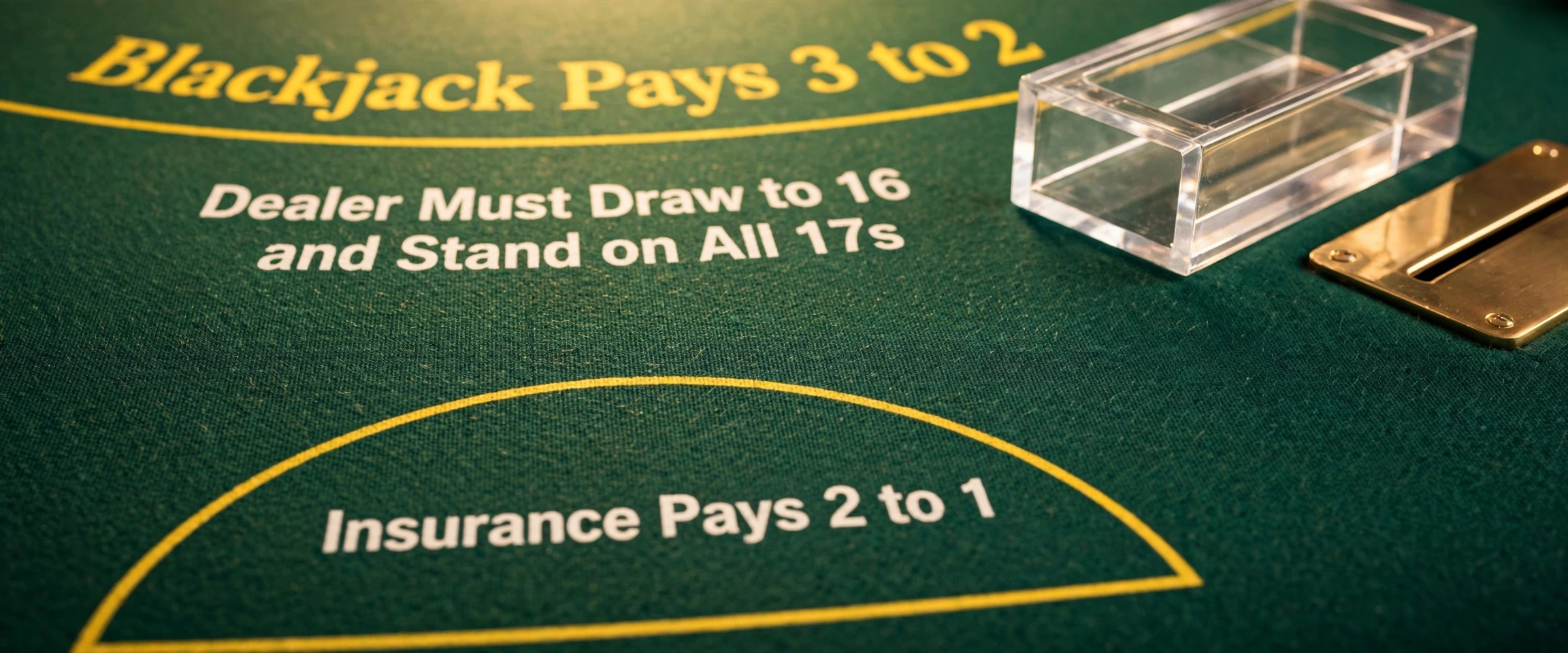
Blackjack is the one table game where the printed rules on the felt matter just as much as player decisions. Two identical looking tables sitting side by side in the same casino pit can carry radically different costs to play. Learning to read table placards for 3:2 payouts, soft 17 rules, and double-down permissions protects your bankroll before placing your first chip.
The Game Objective And Fundamentals
In blackjack, each participant competes exclusively against the dealer. The goal is to obtain a point total closer to 21 than the dealer without exceeding 21 (busting).
Cards two through ten count at face value. Face cards (Jacks, Queens, Kings) are valued at ten points each. Aces count flexibly as either one point or eleven points, depending on which total benefits the hand. A two-card hand consisting of an ace and any ten-point card is a natural "Blackjack," which historically pays a premium bonus.
Basic Strategy: Eliminating Guesswork
Because the dealer must act according to rigid, automated rules, blackjack is mathematically solvable. For every combination of the player's two cards and the dealer's single visible upcard, there exists a single action (hit, stand, double down, split, or surrender) that maximizes expected monetary return.
This optimal matrix is known as "Basic Strategy." When a player executes basic strategy perfectly on a table with favorable rules, the casino's mathematical edge shrinks to approximately 0.4% to 0.6%. Conversely, players who rely on intuition or hunches face an effective house edge of 1.5% to 3.0%, surrendering significant capital over a weekend stay.
The 3:2 Versus 6:5 Payout Disparity
The single most consequential rule in modern casino gaming is the blackjack payout ratio. On a traditional 3:2 table, a winning natural blackjack pays 150% of the initial bet ($15 profit on a $10 wager; $37.50 on a $25 wager).
In recent years, many properties have introduced tables that pay only 6:5 on naturals ($12 on a $10 wager; $30 on a $25 wager). That difference of $7.50 on a $25 bet may seem modest in isolation, but because players receive a natural blackjack approximately once every 21 hands, this reduction transfers enormous revenue to the house.
According to statistical data published by the UNLV Center for Gaming Research, a 6:5 payout adds approximately 1.39 to 1.45 percentage points directly to the house edge. This single rule change nearly triples the cost of playing blackjack. Players should examine the felt and decline participation at any 6:5 table.
Dealer Soft 17: H17 Versus S17
The next critical rule displayed on the felt concerns how the dealer handles a "soft" seventeen (a seven or seventeen formed with an ace counted as eleven, such as Ace-6).
- Dealer Stands on All 17s (S17): The dealer must stop taking cards at seventeen. This favors the player, as the dealer is stuck with a mediocre total that can easily be beaten by an 18, 19, or 20.
- Dealer Hits Soft 17 (H17): The dealer must draw an additional card to an Ace-6. While the dealer risks busting, drawing allows the house to turn a weak holding into an 18, 19, 20, or 21. This rule increases the house edge by roughly 0.22 percentage points.
At premier resorts such as Bellagio and Wynn, H17 rules are common on entry-level main floor tables, while high-limit salons preserve S17 standards.
Double Down, Split Options & Late Surrender
A cluster of secondary table rules further dictates the player's statistical return:
- Double Down After Split (DAS): Allowing players to double their bet after splitting a pair reduces the house edge by 0.14 percentage points. Always seek tables offering DAS.
- Late Surrender: The option to forfeit half your wager and end the hand upon seeing the dealer's upcard (usually against a dealer Ace or Ten). Proper use of late surrender reduces the house edge by approximately 0.08 percentage points and dampens bankroll volatility.
- Re-Splitting Aces (RSA): If you split Aces and receive another Ace, being permitted to split again reduces the house edge by 0.06 percentage points.
- Double Down Restrictions: Some recreational tables restrict doubling to two-card totals of 9, 10, or 11 only (forbidding soft doubling on Ace-7, etc.). This restriction costs the player roughly 0.10 percentage points.
The Insurance Trap And Expensive Side Bets
When the dealer's face-up card is an Ace, the dealer will audibly offer "Insurance." Insurance is a separate side wager of up to half your original bet that the dealer's hidden hole card has a value of ten, forming a natural blackjack. It pays 2 to 1 if successful.
Unless you are counting cards and possess precise knowledge that an abnormal surplus of tens remains in the shoe, insurance is mathematically disadvantageous. In an eight-deck shoe, the house holds an edge of 7.47% on the insurance wager. Basic strategy requires declining insurance under all circumstances, even when you hold a strong hand such as twenty or a natural blackjack ("even money").
Similarly, side bets like 21+3, Perfect Pairs, and Royal Match carry steep casino advantages ranging from 4% to over 13%. They add variance and rapid entertainment, but accelerate expected loss.
Continuous Shuffling Machines (CSMs) And Dealing Speed
Many modern gaming pits utilize Continuous Shuffling Machines (CSMs), where discards from each hand are placed immediately back into an automated rotating shuffler.
While CSMs do not damage basic strategy odds (in fact, slight composition-dependent effects marginally decrease the edge by about 0.03%), they fundamentally alter your hourly expense. Because the dealer never pauses to manually wash and shuffle the cards, dealing continues without interruption. Hands per hour increase from 60 to upwards of 85. More hands per hour mean more cumulative action subjected to the house edge, substantially increasing your average loss per hour of play.
Anatomy Of A Blackjack Table Felt & Placard
Key markings that every player should identify before sitting down:
Comprehensive House Edge Impact Table
Calculated adjustments based on academic baseline rules (six decks, dealer stands on soft 17, double on any two cards, double after split allowed, late surrender allowed), which present a baseline house edge of roughly 0.40%.
| Rule Condition | Standard Setting | Altered Setting | Shift In House Edge | Net Effect On Player |
|---|---|---|---|---|
| Natural Blackjack Payout | Pays 3:2 | Pays 6:5 | +1.39% to +1.45% | Severely disadvantageous |
| Dealer Action on Soft 17 | Dealer Stands (S17) | Dealer Hits (H17) | +0.22% | Unfavorable |
| Double Down After Split (DAS) | DAS Permitted | No DAS Allowed | +0.14% | Unfavorable |
| Late Surrender | Late Surrender Allowed | No Surrender | +0.08% | Slightly unfavorable |
| Deck Count (6 Decks vs 8 Decks) | 6 Decks | 8 Decks | +0.02% | Negligible |
| Deck Count (6 Decks vs Double Deck) | 6 Decks | 2 Decks (Pitch) | -0.19% | Favorable to player |
| Re-Splitting Aces (RSA) | No RSA Allowed | RSA Permitted | -0.06% | Favorable to player |
| Taking Insurance | Declined | Accepted (Multi-Deck) | +7.47% on bet | Extremely costly side wager |
Frequently Asked Blackjack Rules Inquiries
Card counting using only the human mind is completely legal under Nevada state law and federal jurisdiction. However, casinos are private commercial properties. Under Nevada common law, casino management reserves the legal right to refuse service or ask a patron to cease playing blackjack without having to prove illegal activity.
Yes. Plastic basic strategy reference cards are permitted at virtually all regulated casino tables in Nevada, Macao, and Singapore, provided you do not place them directly on the felt betting surface or delay the dealing pace of the table.
Certain specialty games such as Blackjack Switch or Free Bet Blackjack alter the standard natural payout to 1:1 (even money) or push bets on dealer 22s in exchange for allowing unique player perks. These modifications typically produce a house edge between 0.6% and 1.2%, which is superior to 6:5 tables but inferior to traditional 3:2 games.