Baccarat Explained: Card Values, Drawing Rules & Probabilities
Baccarat is the dominant table game in Macao and Singapore, and a centerpiece of high-limit salons in Las Vegas. While the velvet ropes and high stakes project an intimidating image, baccarat is mathematically one of the simplest games on the floor. Players make only a single wagering choice before strict, automatic dealer protocols govern all card distribution.
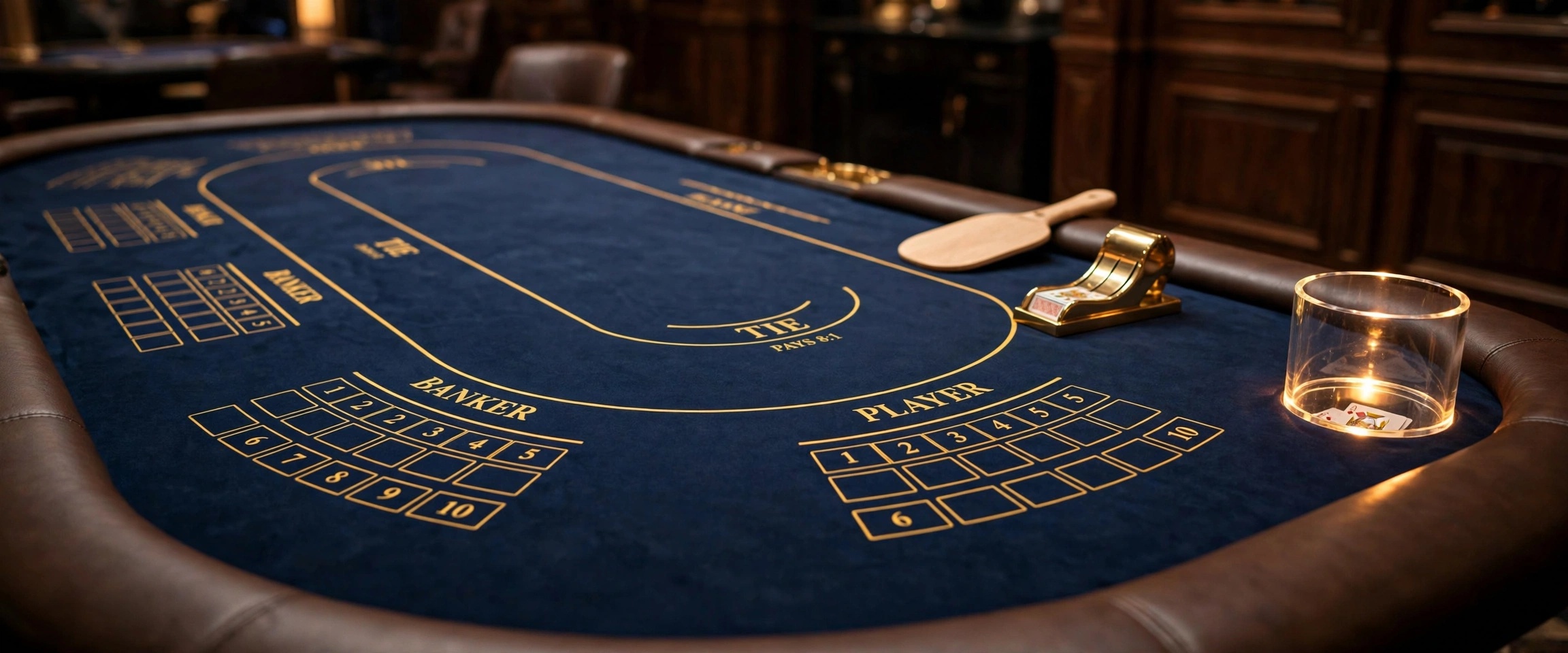
The Three Primary Betting Choices
In baccarat, you do not compete against the dealer or fellow guests. Before any cards leave the dealing shoe, you select one of three outcomes: the Banker hand will win, the Player hand will win, or both hands will finish with an identical total (Tie).
The names "Banker" and "Player" are formal designations for two theoretical hands dealt on the felt layout. Wagering on the Banker hand does not require you to bank or finance the table, nor does wagering on the Player hand mean you are representing yourself. You are merely wagering on the outcome of a pre-determined card dealing sequence.
Card Values And Modulo Ten Calculation
Baccarat hand values are calculated using modulo ten arithmetic, meaning only the final digit of the cumulative sum counts:
- Aces: Valued strictly at one point.
- Cards Two through Nine: Valued at face value (a five is worth five, an eight is worth eight).
- Tens, Jacks, Queens, and Kings: Valued strictly at zero points.
When the sum of cards reaches double digits, the tens digit is discarded entirely. For example, a seven and an eight total fifteen, which becomes a hand value of five. A six and a four total ten, which becomes a hand value of zero (known historically as baccarat). The highest possible hand total is nine.
The Third Card Drawing Rules (Tableau)
Each hand initially receives two cards from an eight-deck shoe. If either the Player or the Banker totals eight or nine on the first two cards, this is classified as a "Natural." The round concludes immediately, and the higher total wins. If neither hand holds a natural, fixed drawing rules dictate subsequent action without any player discretion.
Player Hand Rules
The Player hand always acts first. If the Player's two-card total is 0, 1, 2, 3, 4, or 5, the Player hand must draw a third card. If the Player total is 6 or 7, the Player hand must stand.
Banker Hand Drawing Logic
If the Player stood on two cards (holding a 6 or 7), the Banker simply draws on 0 through 5 and stands on 6 or 7. However, if the Player drew a third card, the Banker follows a precise mathematical tableau based on the Banker's current two-card total and the exact face value of the Player's third card:
Specifically, when the Banker holds:
- Total of 3: Banker draws unless Player's 3rd card was an 8.
- Total of 4: Banker draws if Player's 3rd card was 2, 3, 4, 5, 6, or 7.
- Total of 5: Banker draws if Player's 3rd card was 4, 5, 6, or 7.
- Total of 6: Banker draws only if Player's 3rd card was a 6 or 7.
- Total of 7: Banker always stands.
Why The Banker Hand Pays A Five Percent Commission
Because the Banker hand acts second, the drawing rules grant the Banker an inherent statistical advantage. Across an eight-deck shoe, the mathematical outcomes distribute as follows:
- Banker Hand Wins: 45.86%
- Player Hand Wins: 44.62%
- Tie Outcome: 9.52%
Excluding ties (where bets on Banker and Player are refunded as a push), the Banker hand wins approximately 50.68% of decided rounds. If casinos paid even money (1:1) on Banker wins, the player would hold a long-term advantage over the house.
To correct for this imbalance, casinos levy a standard 5% commission on winning Banker wagers. If you wager $100 on Banker and win, you receive $95 in profit. Even after accounting for this 5% deduction, the Banker bet remains the most cost-effective wager on the table, yielding a house edge of 1.06%, compared to 1.24% on the Player wager.
The No-Commission Baccarat (Super 6) Trap
In many casino environments, particularly across mass-market pits in Macao and Singapore, operators feature "No-Commission Baccarat" (often marketed as Punto Banco or Super 6).
On these tables, all winning Banker bets pay full even money (1:1) without the administrative delay of calculating 5% change. However, there is a major caveat: when the Banker hand wins with a total of exactly six, the winning Banker bet pays only 50% (1 to 2).
While this adjustment accelerates dealer hand settlement, mathematical analysis published by the Stanford University Department of Statistics confirms that this single payout modification increases the house edge on the Banker bet from 1.06% to roughly 1.46%. Whenever a choice is available, traditional 5% commission tables provide superior odds for the participant.
Tie Wagers And Derivative Side Bets
Beside the primary Banker and Player betting boxes sit various high-payout side propositions:
- The Tie Bet (8 to 1 Payout): While an 8:1 payout appears appealing, the mathematical probability of a tie is only 9.52%. This results in a staggering house edge of 14.36%. On rare layouts where Tie pays 9 to 1, the edge drops to 4.84%, which remains four times more expensive than the Banker bet.
- Player Pair & Banker Pair (11 to 1): Wagering that the first two cards dealt to a specific side will form a pair. The house edge on standard eight-deck shoes sits at 10.36%.
- Dragon 7 (EZ Baccarat): Pays 40 to 1 if the Banker wins with a three-card total of seven. House edge: 7.61%.
- Panda 8 (EZ Baccarat): Pays 25 to 1 if the Player wins with a three-card total of eight. House edge: 10.19%.
The Squeeze Ritual & Electronic Roadmaps
In premium VIP salons throughout Cotai and Singapore, players who place the highest wager on a given side are granted the privilege of "squeezing" the cards: bending and peeling them slowly to reveal edge pips before turning the card face up.
While this ritual generates dramatic table theater, it exerts zero influence on the outcome. The cards have already been dealt from a shuffled physical or automated shoe.
Similarly, the large electronic monitor mounted above every table displays historical pattern charts: the Bead Plate, Big Road, Big Eye Boy, Small Road, and Cockroach Pig. These matrices track streaks of consecutive Banker or Player wins. In probability theory, each coup in a fair deck represents an independent event. Past sequences do not dictate future dealing outcomes. Treating historical roadmaps as predictive trends represents a classic manifestation of the gambler's fallacy.
Eight-Deck Baccarat Mathematical Odds Matrix
Verified probability statistics across standard eight-deck shoes based on computational gaming research compiled by UNLV Center for Gaming Research:
| Wager Type | Standard Payout | Win Probability | House Edge | Strategic Recommendation |
|---|---|---|---|---|
| Banker (5% Commission) | 0.95 to 1 | 45.86% (50.68% resolved) | 1.06% | Primary recommended wager |
| Player | 1 to 1 | 44.62% (49.32% resolved) | 1.24% | Sound secondary wager |
| Banker (No-Comm, 6 pays 50%) | 1 to 1 (0.5 to 1 on 6) | 45.86% | 1.46% | Inferior to 5% commission |
| Tie Wager (8 to 1) | 8 to 1 | 9.52% | 14.36% | Avoid completely |
| Tie Wager (9 to 1) | 9 to 1 | 9.52% | 4.84% | Significantly higher than main bets |
| Banker Pair / Player Pair | 11 to 1 | 7.47% | 10.36% | Expensive novelty side bet |
Frequently Asked Baccarat Inquiries
Mathematical studies, including early research by Dr. Edward O. Thorp, demonstrate that card counting in baccarat yields virtually zero practical edge. Because cards leaving the shoe affect both Banker and Player hands almost symmetrically, the edge shift is too minuscule to overcome the 5% commission in practical casino play.
If the Banker and Player hands finish with identical totals and you wagered on Banker or Player, your wager is returned in full as a push. Only dedicated wagers placed directly on the Tie betting space receive payout winnings.
The rules and mathematics are identical. Mini-Baccarat is played on a smaller blackjack-style table with lower minimums where the dealer handles all cards rapidly. Midi and Big Baccarat are played on large kidney-shaped tables in roped salons with higher stakes, where players handle and squeeze the cards.